---
title: Summer Heat Safety for Fleet Wash Crews
description: Ensure your fleet wash crew stays safe in summer heat. Learn the risks of heat illness, signs to watch for, and essential safety protocols to implement.
image: https://blog.hydrochemsystems.com/hubfs/Summer%20Heat%20Safety%20for%20Fleet%20Wash%20Crews%20Blog%20Header.png
---
[](https://hydrochemsystems.com/)
- [Automated Truck Systems](https://hydrochemsystems.com/automated-truck-systems/)
- [Private Fleets](https://hydrochemsystems.com/automated-truck-systems/private-fleets/)
- [Commercial & Retail](https://hydrochemsystems.com/automated-truck-systems/commercial-retail-public-fleet-wash/)
- [Bus Wash Systems](https://hydrochemsystems.com/automated-truck-systems/bus-wash-systems/)
- [Waste & Municipal](https://hydrochemsystems.com/automated-truck-systems/waste-municipal-fleet-wash-systems/)
- [Heavy Duty](https://hydrochemsystems.com/automated-truck-systems/heavy-duty/)
- [Biosecurity](https://hydrochemsystems.com/automated-truck-systems/biosecurity-wash/)
- [Undercarriage](https://hydrochemsystems.com/automated-truck-systems/undercarriage-only/)
- [Chemicals](https://hydrochemsystems.com/chemicals/)
- [Truck Wash Soaps](https://hydrochemsystems.com/chemicals/truck-wash-soaps/)
- [Specialty Fleet Products](https://hydrochemsystems.com/chemicals/specialty-fleet-products/)
- [Degreasers](https://hydrochemsystems.com/chemicals/degreasers-and-floor/)
- [Mobile Fleet Solutions](https://hydrochemsystems.com/mobile-fleet-solutions/)
- [About Us](https://hydrochemsystems.com/about-us/)
- [Blog](https://blog.hydrochemsystems.com/)
- [Case Studies](https://hydrochemsystems.com/about-us/case-studies/)
- [Careers](https://hydrochemsystems.com/about-us/careers/)
[GET A QUOTE](https://hydrochemsystems.com/contact-us/)
[GET A QUOTE](https://hydrochemsystems.com/contact-us/)
[Education & Knowledge](https://blog.hydrochemsystems.com/tag/education-knowledge) | [Automated Wash](https://blog.hydrochemsystems.com/tag/automated-wash) | [Fleet Washing Tips](https://blog.hydrochemsystems.com/tag/fleet-washing-tips) | [truck wash business](https://blog.hydrochemsystems.com/tag/truck-wash-business) | [Mobile Washing](https://blog.hydrochemsystems.com/tag/mobile-washing) | [Insight](https://blog.hydrochemsystems.com/tag/insight)
## Summer Heat Safety for Fleet Wash Crews
July 20, 2026
by [Chad Reiffer](https://blog.hydrochemsystems.com/author/chad-reiffer)
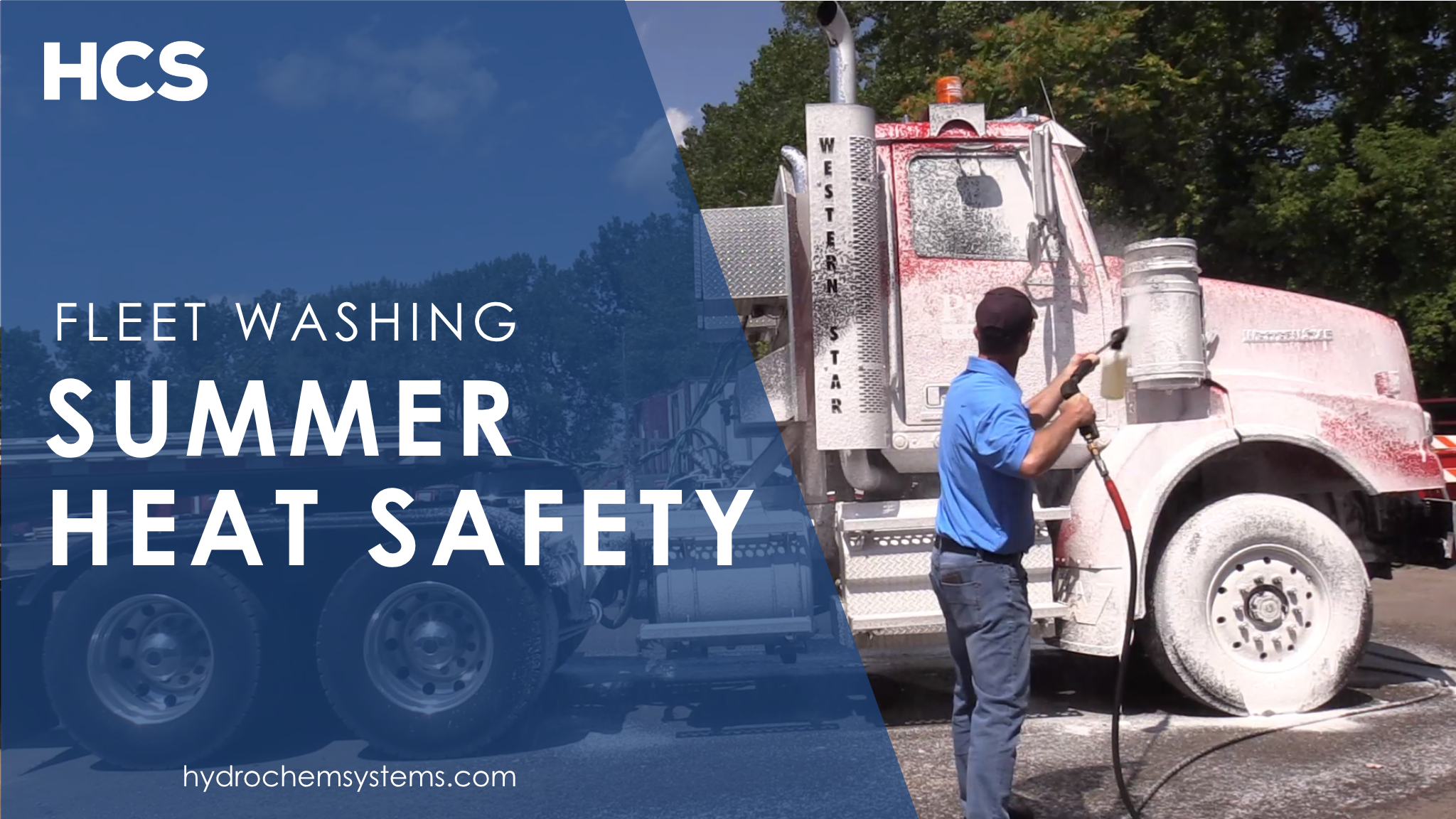
Washing fleets in summer heat is different from washing them in early April. The way your soap behaves isn't the only thing that changes when the temperature climbs. The risk to your crew changes, too.
Fleet wash crews face a specific kind of heat risk that a lot of general summer safety advice misses. Adding to the risk is that some of the biggest warning signs don't feel dangerous until it's too late. This guide covers what makes wash bay work different, what to watch for, and what to do if someone on your crew starts showing signs of heat illness.
Let’s keep everyone safe this summer.
[Download our free quick guide](https://blog.hydrochemsystems.com/hubfs/HOT%20WEATHER%20WASH%20SAFETY%20DOWNLOAD.pdf)
### Why Wash Crews Face a Different Kind of Heat Risk
If your crew wears PPE, aprons, or rain gear, that gear is working against them as much as it's protecting them. Rain gear and aprons block the sweat evaporation your body relies on to cool down. The result is that heat builds up faster on a wash crew member than it would on someone doing the same physical work without PPE.
If your crew isn't in full PPE, overspray creates a different problem. Getting hit with cool water all day can feel like relief, and that feeling can mask how much someone is actually sweating. It's the same sensation as swimming in a lake. The water pulls heat off your skin, so you feel fine, even while you're losing fluid the whole time.
Hot weather can also cause your team to be tempted to reduce or remove PPE just to get relief from the heat, causing another layer of risk on top of temperatures. The overspray of cool water might actually be overspray from a chemical, and without the protection of PPE, the risk is greatly increased and potentially even toxic.
Either way, the risk is the same: your crew can feel okay right up until they're not.
### Know the Signs: Heat Exhaustion vs. Heat Stroke
Heat exhaustion shows up as heavy sweating, cramps, dizziness, headache, nausea, and a racing heart rate. Someone with heat exhaustion can still think clearly and talk normally.
Heat stroke is more serious, and it can develop quickly. Watch for skin that's stopped sweating, confusion, slurred speech, and a body that feels dangerously hot. If someone's body can't cool itself down anymore, that's an emergency, not a "sit down and drink water" situation.
### What to Do
For heat exhaustion: get the person to shade or air conditioning, help them cool down, get them drinking water, and have them rest before going back to work.
For heat stroke, call 911 immediately. Cool the person down while you wait for help to arrive. Don't wait to see if it passes on its own. Every minute matters.
## Build This Into Your Summer Routine
The best heat safety plan is one your crew already knows before the first hot shift of the season. Brief your team on these signs before summer heat hits, not after someone's already in trouble.
We'd rather you take the extra break than push through it. [Download our free quick guide to keep on hand.](https://blog.hydrochemsystems.com/hubfs/HOT%20WEATHER%20WASH%20SAFETY%20DOWNLOAD.pdf)
### Hydro-Chem Systems
6605 Broadmoor Ave SE
Caledonia, MI 49316
**Monday – Friday**
8:00AM – 4:00PM
Phone: [616-531-6420](tel:6165316420)
**Service:** [833-427-3183](tel:8334273183)
**Email:** [info@hcsclean.com](mailto:info@hcsclean.com)
[Request a Quote](https://hydrochemsystems.com/contact-us/)
- Quick Links
- [About Us](https://hydrochemsystems.com/about-us/)
- [MICHIGAN FLEET WASH SOLUTIONS](https://hydrochemsystems.com/michigan-fleet-washing-solutions/)
- [FLEET WASH EFFICIENCY AUDIT](https://hydrochemsystems.com/fleet-wash-efficiency-audit/)
- [SERVICE DEPARTMENT](https://hydrochemsystems.com/service-department/)
- [PARTS & WASHERS](https://hydrochemsystems.com/parts-washers/)
- [DISTRIBUTION](https://hydrochemsystems.com/distribution/)
- [CONTACT US](https://hydrochemsystems.com/contact-us/)
### What Our Customers Think
[](https://admin.trustindex.io/api/googleReview?place-id=ChIJ1aYrzfmzGYgREwW4ELjXPEY)
[Leave us a Review](https://search.google.com/local/writereview?placeid=ChIJ1aYrzfmzGYgREwW4ELjXPEY)
[](https://hydrochemsystems.com/)
2026 HYDRO-CHEM SYSTEMS | [PRIVACY POLICY](https://hydrochemsystems.lkfhosting.com/privacy-policy/)
```json
{
"@context" : "https://schema.org",
"@type" : "BlogPosting",
"author" : {
"@type" : "Person",
"name" : "Chad Reiffer",
"url" : "https://blog.hydrochemsystems.com/author/chad-reiffer"
},
"dateModified" : "2026-07-22T12:20:08.885Z",
"datePublished" : "2026-07-20T14:15:00.000Z",
"headline" : "Summer Heat Safety for Fleet Wash Crews",
"image" : [ "https://blog.hydrochemsystems.com/hubfs/Summer%20Heat%20Safety%20for%20Fleet%20Wash%20Crews%20Blog%20Header.png" ],
"mainEntityOfPage" : {
"@id" : "https://blog.hydrochemsystems.com/summer-heat-safety-for-fleet-wash-crews",
"@type" : "WebPage"
},
"publisher" : {
"@type" : "Organization",
"logo" : {
"@type" : "ImageObject",
"url" : "https://blog.hydrochemsystems.com/hubfs/Hydro-Chem%20Systems%20Logo%20Transparent%20Background.png"
},
"name" : "Hydro-Chem Systems Inc. "
}
}
```