---
title: Your Wash System Works. Your Drivers Don’t Trust It.
description: Discover why fleet drivers resist automated wash systems and how touchless options can enhance trust, efficiency, and vehicle care for your fleet.
image: https://blog.hydrochemsystems.com/hubfs/Your%20Wash%20System%20Works.%20Your%20Drivers%20Don%E2%80%99t%20Trust%20It.%20blog.png
---
[](https://hydrochemsystems.com/)
- [Automated Truck Systems](https://hydrochemsystems.com/automated-truck-systems/)
- [Private Fleets](https://hydrochemsystems.com/automated-truck-systems/private-fleets/)
- [Commercial & Retail](https://hydrochemsystems.com/automated-truck-systems/commercial-retail-public-fleet-wash/)
- [Bus Wash Systems](https://hydrochemsystems.com/automated-truck-systems/bus-wash-systems/)
- [Waste & Municipal](https://hydrochemsystems.com/automated-truck-systems/waste-municipal-fleet-wash-systems/)
- [Heavy Duty](https://hydrochemsystems.com/automated-truck-systems/heavy-duty/)
- [Biosecurity](https://hydrochemsystems.com/automated-truck-systems/biosecurity-wash/)
- [Undercarriage](https://hydrochemsystems.com/automated-truck-systems/undercarriage-only/)
- [Chemicals](https://hydrochemsystems.com/chemicals/)
- [Truck Wash Soaps](https://hydrochemsystems.com/chemicals/truck-wash-soaps/)
- [Specialty Fleet Products](https://hydrochemsystems.com/chemicals/specialty-fleet-products/)
- [Degreasers](https://hydrochemsystems.com/chemicals/degreasers-and-floor/)
- [Mobile Fleet Solutions](https://hydrochemsystems.com/mobile-fleet-solutions/)
- [About Us](https://hydrochemsystems.com/about-us/)
- [Blog](https://blog.hydrochemsystems.com/)
- [Case Studies](https://hydrochemsystems.com/about-us/case-studies/)
- [Careers](https://hydrochemsystems.com/about-us/careers/)
[GET A QUOTE](https://hydrochemsystems.com/contact-us/)
[GET A QUOTE](https://hydrochemsystems.com/contact-us/)
[Education & Knowledge](https://blog.hydrochemsystems.com/tag/education-knowledge) | [automated fleet wash](https://blog.hydrochemsystems.com/tag/automated-fleet-wash) | [Automated Wash](https://blog.hydrochemsystems.com/tag/automated-wash) | [Fleet Washing Tips](https://blog.hydrochemsystems.com/tag/fleet-washing-tips) | [maintenance](https://blog.hydrochemsystems.com/tag/maintenance) | [Insight](https://blog.hydrochemsystems.com/tag/insight)
## Your Wash System Works. Your Drivers Don’t Trust It.
May 01, 2026
by [Keith Bailey](https://blog.hydrochemsystems.com/author/keith-bailey)
It's like having a mini rebellion on your hands: Fleet drivers refusing to take their rigs through your automated gantry wash system. About 12 minutes per truck should feel like a win after years of scheduling mobile washers. But drivers don't appreciate the brushes that tear off mirrors and scratch their graphics.
The frustrating part is that this new automated system was supposed to save you time and money. By letting the nozzles and brushes do the work, you no longer have to contract out your washing.
But once a brush system damages one mirror, word spreads. Trust breaks fast. Drivers start parking dirty trucks rather than risk the wash bay.
The equipment you bought to save time becomes the problem everyone avoids. It doesn't matter how fast the system runs if nobody uses it.
## Why Brushes in the First Place?
One of the selling points of brush systems, whether gantry or drive-through, is efficiency. They tend to use less water and electricity than touchless systems. They also cut wash time from an hour or more down to about 15 minutes (gantry) to 3 minutes (drive-through) per vehicle, compared to mobile washing.
The promise of faster washes that use less water and soap [closes deals](https://blog.hydrochemsystems.com/education-and-knowledge/pros-cons-automated-drive-thru-truck-wash-vs-gantry-style-wash).
They accomplish this with mechanical action, the friction of brushes, instead of chemical reactions and high-pressure water. Physical force scrapes away grime.
You end up with a great clean while using less soap and less water. But you also have brushes that scrape along the surface of your vehicles to make it work. And this is where the problems start.
## Why Drivers Stop Trusting Brush Systems
Brush systems, whether gantry or drive-through, need programming to follow vehicle contours. It's supposed to keep the brushes where they need to be. But in the real world, there are hundreds of possible configurations.
The brushes activate at specific points around the vehicle. If the system isn't programmed for that specific layout, the brushes don't know where your exhaust stacks, mirrors, and bumpers are. When it gets it wrong, you end up with expensive damage.
The gap between a cab and trailer creates the same problem. Brushes follow the vehicle contour until they hit that space. Then they drop into the gap and get stuck. When a brush gets caught, something has to give. Usually, it's the top brush assembly. Replacement runs $8K to $12K plus two to three days of downtime.
Graphics and vinyl wraps create additional problems. Brushes can pick up sand, salt, and road debris during normal operation. If those brushes aren't cleaned regularly, they carry tiny pieces of grit that scratch paint and damage expensive wrapping as they spin against the vehicle. Drivers notice.
Just a couple of incidents create a reputation that keeps drivers, mechanics, and fleet managers from using your wash equipment.
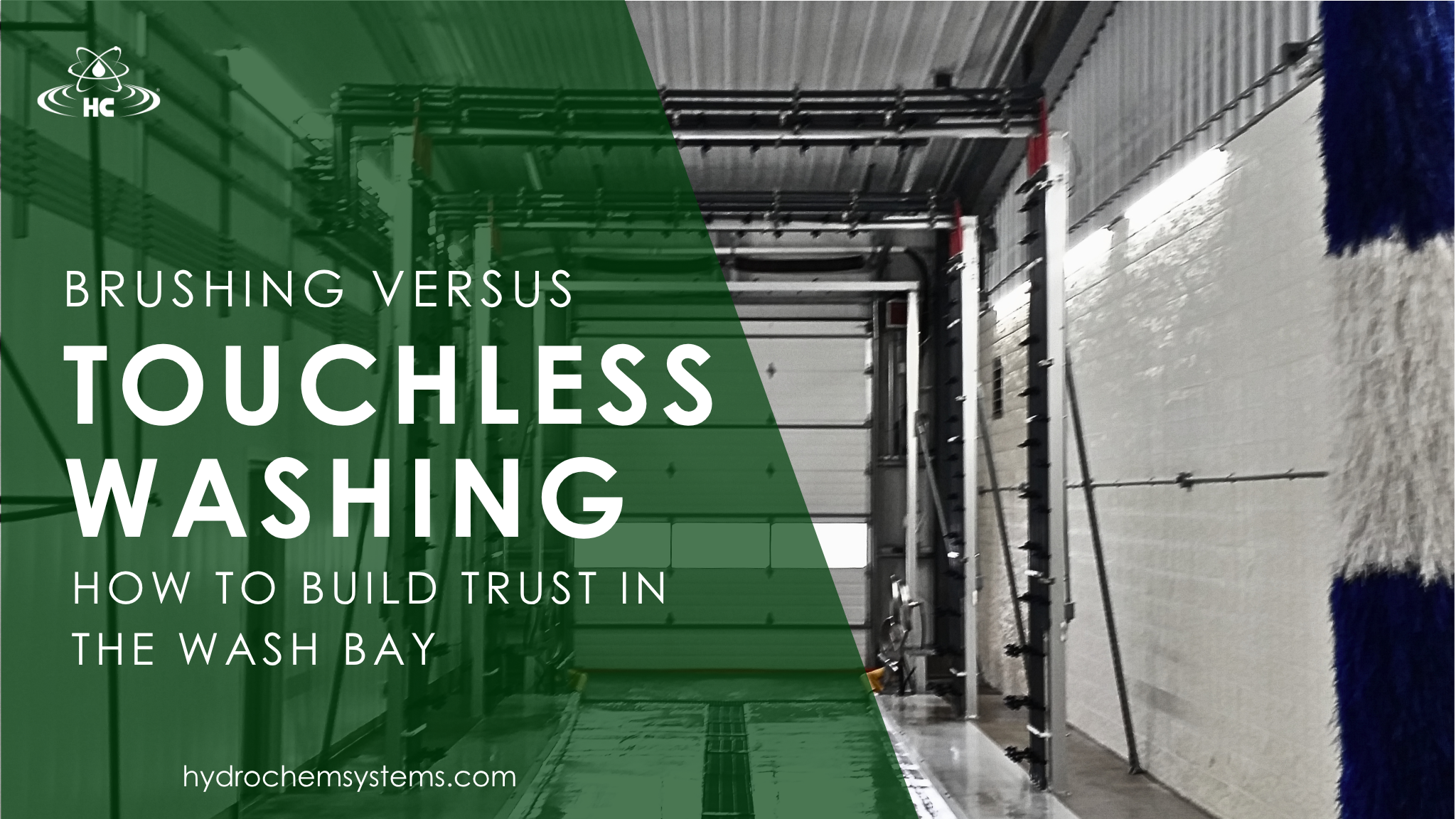
## Touchless Systems Are … Brushless.
Nothing but water and soap touches the vehicle. That's it. That's the whole idea.
No brushes means no extra programming for brushes to avoid vehicle contours. No worries about mirror positions or exhaust stack heights. No risk of brushes dropping into gaps and ripping off assemblies.
Chemistry and water dissolve grime and rinse it off rather than scraping it away.
And, as another bonus, touchless often means a drive-through system. This not only cuts your wash time down to 1-3 minutes but also means there’s less chance for [mechanical issues that gantry or roll-over systems](https://blog.hydrochemsystems.com/broken-gantry-system-alternative) often bring.
## Comparing Your Options
**Brush systems can cost less to operate.** When they are washing, they use less water and less soap. It’s the brushes doing most of the work.
**But operating costs tell a different story over time.** In a gantry or roll-over system, maintenance requirements run significantly higher due to moving parts, actuators, sensors, chains, and brushes. After about five years, the accumulated maintenance costs and downtime typically erase the initial savings.
**Fleet variety creates additional challenges.** Even if you run the same vehicle type, different model years can have different mirror positions or body configurations. Each variation requires programming attention. The more variety in your fleet, the higher the risk for damage.
**Touchless drive-through systems eliminate the programming problem.** Pickup trucks, tankers, and school buses can all wash using the same settings because nothing needs to follow vehicle contours. Your fleet composition can change without requiring system reprogramming.
Brush systems work when your fleet is uniform. A few vehicle profiles cover most situations. But add an oddball shape, and you're back to programming work or risking damage if you skip it. Touchless systems handle variety without the risk.
**Graphics and paint impact branding and appearance.** Touchless systems use chemistry instead of friction to remove grime. Brushes leave micro-swirls on paint and scratches on graphics. Even well-maintained brushes cause this wear. Over time, paint and graphics dull out and need replacement.
## Keeping Your Fleet Clean
Durability and driver adoption matter more than installation price. A system that sits idle because nobody trusts it delivers zero value, regardless of efficiency specs or purchase price.
If your current wash system is causing driver resistance, that's a signal worth paying attention to. Damaged mirrors and scratched graphics don't just cost money to repair. They cost you the trust that keeps your fleet clean.
Want to stay current on fleet washing trends and techniques? Our monthly newsletter covers what's worth your attention. [Sign up here](https://info.hydrochemsystems.com/newsletter-signup).
### Hydro-Chem Systems
6605 Broadmoor Ave SE
Caledonia, MI 49316
**Monday – Friday**
8:00AM – 4:00PM
Phone: [616-531-6420](tel:6165316420)
**Service:** [833-427-3183](tel:8334273183)
**Email:** [info@hcsclean.com](mailto:info@hcsclean.com)
[Request a Quote](https://hydrochemsystems.com/contact-us/)
- Quick Links
- [About Us](https://hydrochemsystems.com/about-us/)
- [MICHIGAN FLEET WASH SOLUTIONS](https://hydrochemsystems.com/michigan-fleet-washing-solutions/)
- [FLEET WASH EFFICIENCY AUDIT](https://hydrochemsystems.com/fleet-wash-efficiency-audit/)
- [SERVICE DEPARTMENT](https://hydrochemsystems.com/service-department/)
- [PARTS & WASHERS](https://hydrochemsystems.com/parts-washers/)
- [DISTRIBUTION](https://hydrochemsystems.com/distribution/)
- [CONTACT US](https://hydrochemsystems.com/contact-us/)
### What Our Customers Think
[](https://admin.trustindex.io/api/googleReview?place-id=ChIJ1aYrzfmzGYgREwW4ELjXPEY)
[Leave us a Review](https://search.google.com/local/writereview?placeid=ChIJ1aYrzfmzGYgREwW4ELjXPEY)
[](https://hydrochemsystems.com/)
2026 HYDRO-CHEM SYSTEMS | [PRIVACY POLICY](https://hydrochemsystems.lkfhosting.com/privacy-policy/)
```json
{
"@context" : "https://schema.org",
"@type" : "BlogPosting",
"author" : {
"@type" : "Person",
"name" : "Keith Bailey",
"url" : "https://blog.hydrochemsystems.com/author/keith-bailey"
},
"dateModified" : "2026-05-04T18:46:07.553Z",
"datePublished" : "2026-05-01T12:00:00.000Z",
"headline" : "Your Wash System Works. Your Drivers Don’t Trust It.",
"image" : [ "https://blog.hydrochemsystems.com/hubfs/Your%20Wash%20System%20Works.%20Your%20Drivers%20Don%E2%80%99t%20Trust%20It.%20blog.png" ],
"mainEntityOfPage" : {
"@id" : "https://blog.hydrochemsystems.com/brushless-vs-touchless-automated-fleet-wash",
"@type" : "WebPage"
},
"publisher" : {
"@type" : "Organization",
"logo" : {
"@type" : "ImageObject",
"url" : "https://blog.hydrochemsystems.com/hubfs/Hydro-Chem%20Systems%20Logo%20Transparent%20Background.png"
},
"name" : "Hydro-Chem Systems Inc. "
}
}
```